mixed use
Discover the hidden history of Cranford Park at this special open day. Explore the beautifully restored Grade II listed 18th-century stables and the secluded Secret Garden, once the estate's kitchen courtyard. Learn how these surviving buildings reveal life behind the scenes of the lost Cranford House estate and the ongoing conservation of this remarkable historic landscape.
Hayes & Harlington
E6
Lift access to cellars
Originally the site of 2 medieval manors - one of which was controlled by the Knights Templar and Hospitaller - it passed from church to private ownership during the reformation.
After the dissolution of the monasteries. both manors were confiscated by Henry VIII, who presented them to Andrew, Lord Windsor and they remained in the Windsor family until 1594.
In 1604, the park was brought by Sir Roger Aston, an officer of the Court of James I. He held the impressive offices of Barber, Gentleman of the Bedchamber and Keeper of the Great Wardrobe. He would have served the king closely, as the profession of barber was allied to that of a modern-day surgeon.
In 1618, after the death of Sir Roger, Lady Elizabeth Berkeley, widow of Sir Thomas Berkeley, purchased the park for £7,000. We know that during this period the park had a dovecote, icehouse, brew house, dairy, granary, dog kennels, rectory, lodge house, windmill skittle ground, croquet lawn, wilderness and several orchards.
George Berkeley, the 1st Earl, was a founding member of the Royal African Company and a member of the East India Company. The 3rd Earl, James Berkeley, served as the First Lord of the Admiralty from 1717 to 1727.
The 5th Earl of Berkeley and his wife Mary stand out amongst the residents of Cranford Park. Fredrick Augustus Berkeley inherited the title of Earl of Berkeley in 1755 and held it until his death in 1810. His marriage to Mary Cole (also known as Mary Tudor), the daughter of a Gloucester butcher, was a constant cause of controversy. The date of their wedding was disputed, with the earliest confirmed date taking place in 1796, by which point they already had six children with a seventh on the way. At this time, the family's doctor was Edward Jenner, a man more famous now for developing the first vaccines.
The Earl was famous for other eccentricities. This included his public statements on highwaymen, where he claimed that it wasn't a disgrace to be overcome by superior numbers, but that he would never surrender to a lone assailant. Allegedly, this theory was tested whilst travelling across Hounslow Heath. Stopped by a lone highway man, the Earl is reported to have looked over the man's shoulder and told him he could see his accomplices hiding in the shadows. The man, who was alone, panicked at the thought that someone was behind him and turned to see who it was. As he did, the Earl is said to have pulled out his own pistol and shot the highwayman dead.
Following a period of near abandonment, which started when the Berkeley's quit the site in 1918, the main house was demolished in 1945, leaving only the cellars, stables, stable courtyard, kitchen garden and ha-ha surviving.
The restoration of Cranford Park began on site last May, and the construction works are nearing completion.
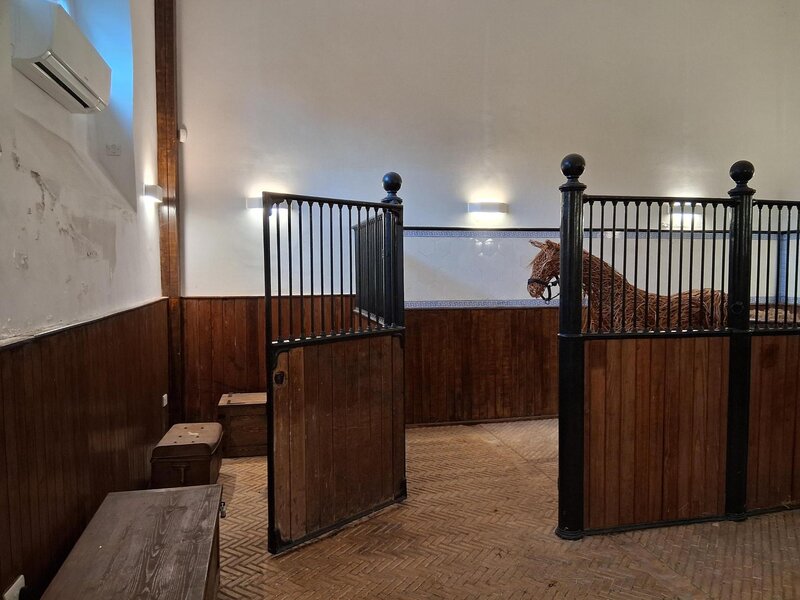
The stables were in very poor condition. They were damp with dry rot and woodworm and some of the key roof timbers were very rotten. The roof, windows and doors had been badly vandalised and part of the interior was smoke blackened from a fire.
They have now been repaired, the upper floors ceiled, replastered, repainted and the windows double glazed. Heating, lighting, smoke alarms and wifi have been introduced. The heating will be powered by air source heat pumps.
There is a little more work to be done at ground floor.
The café is being built on the floor plan of Cranford House, which was demolished in 1945. The brickwork is from a local family firm, HG Matthews, and it has a green roof. 2 sides of the dining room will be glazed - the south side will look out over the meadows and the west side over to the new playground. The outdoor sitting area (under the black plastic, which is protecting the cellars below) will be set out within the rooms of the old house.
The cellars have been repaired and cleared of rubble. Lighting has been installed, together with a heating and ventilation system. The public will be able to visit the cellars via the café entrance and view a film about Cranford Park and other interpretation displays there.
The Grade II listed stable block dates primarily from 1722, when the 3rd Earl of Berkeley rebuilt Cranford House and remodelled the estate. Designed to serve a grand country house, the stables originally contained 28 horse stalls and loose boxes, reflecting the importance of horses for transport, hunting and entertaining guests.
Although Cranford House was demolished after the Second World War, much of the stable block survived. Following extensive restoration funded by the National Lottery Heritage Fund and partners, it has been repaired using traditional materials and now serves as a heritage and community space, preserving original features while interpreting the estate's history.
You can visit this place of rich heritage as part of Open House Festival 2026
he "Secret Garden" is actually the former kitchen courtyard of Cranford House. Enclosed by high brick walls between the stables and the house, it was originally a working service area connected directly to the mansion's kitchens. Archaeological work uncovered a historic well, and traces of blocked doorways reveal how staff once moved between the house and service buildings. It was transformed into a garden in 2002 and is now maintained by volunteers from the Friends of Cranford Park.
Today it is a quiet, enclosed space that illustrates the hidden "back-of-house" workings of an 18th-century country estate while also providing a habitat for wildlife and a community garden.
Together, the stables and Secret Garden are among the few surviving physical reminders of the Berkeley family's estate and help tell the story of Cranford House long after the mansion itself disappeared.