religious
Sir Arthur Blomfield, 1884
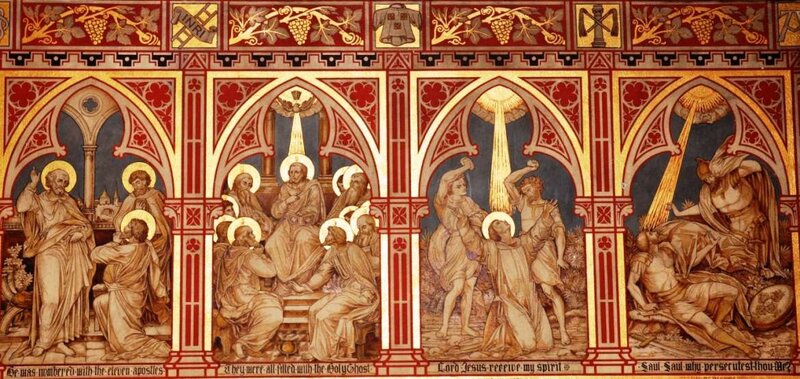
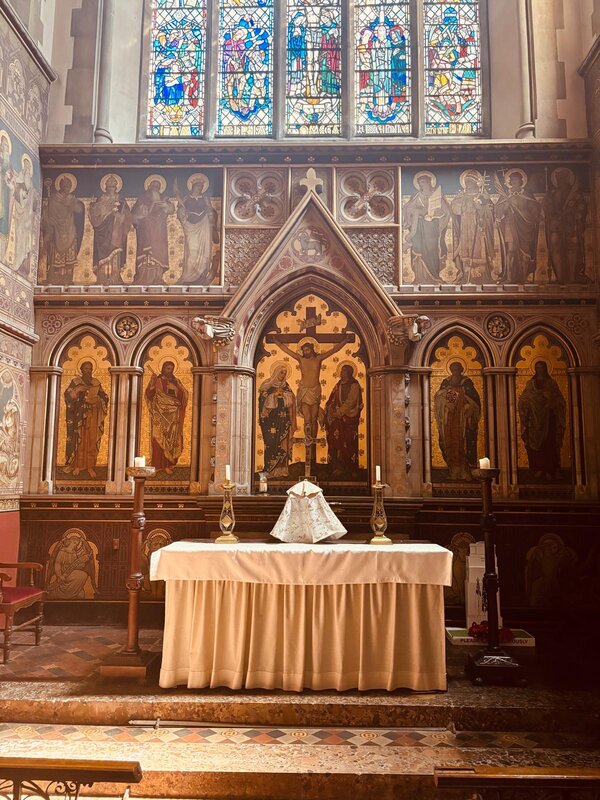
St Andrew's is a Grade II* listed church in the heart of Stamford Hill. With remarkable and unique wall paintings designed by Blomfield/Heaton Butler and Bayne, the murals were painted by Alexander Higerty. The building was completed in 1884, and the artwork after World War I when Higerty returned to create a war memorial for the fallen and a plaque of thanksgiving for those who returned.
Manor House
Stamford Hill
253, 254, 149, 243, 67, 76
The church is a peaceful sacred space. There is plenty of seating to rest and take a moment to reflect.
Consecrated in 1884, St Andrew’s was built to serve a growing Victorian suburb newly connected to central London by the railway. Designed by Arthur Blomfield, it originally stood in open fields – “not yet a shop or a public house in the parish,” as the first vicar recalled.
Early worshippers arrived to a surprisingly bare building: no heating, no bell, no font, and very little decoration. Over time, however, the church was gradually transformed through the generosity of its congregation. Almost everything you see today – from the striking murals to the stained glass – was funded piece by piece by local people.
The decoration forms one of the church’s greatest treasures. A scheme was developed by the architect, Arthur Blomfield, in collaboration with Heaton, Butler and Bayne, and brought to life by artists including muralist Alexander Higerty, who painted all but one of the murals. It tells the story of Jesus in a vivid sequence across the walls. Rich colour, gold backgrounds, and intricate detail draw the eye, particularly in the Chancel where the crucifixion scene forms a powerful focal point.
St Andrew’s also bears the marks of history. A V1 rocket in 1944 destroyed many windows on the south side, which were later replaced with clear glass, trimmed with fragments gathered from bombed churches across London. Memorials throughout the building honour those connected with the parish who served in the World Wars, not only those who lost their lives, but also those who returned.
Today, St Andrew’s is both a place of worship and a work of art – shaped over time by faith, community, and resilience. Visitors are warmly invited to explore its stories, symbols, and quiet beauty.