historical house, community/cultural, gallery, museum
Unknown, 1704
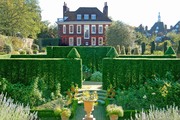
Built in 1704 and 1720, Burgh House is a Grade I Listed Queen Anne and early Georgian house situated in the heart of Hampstead Village. As an independent charity, it serves as a cultural hub bringing together heritage, art and community programming. Burgh House is also an Arts Council England accredited museum with a collection relating to Burgh House and the local area.
Hampstead
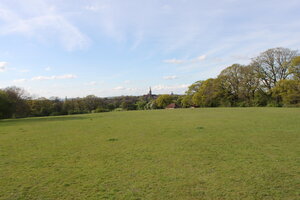
Hampstead Heath
46, 268, 210
Unfortunately, due to the building’s Grade I-listed status, there is currently no step-free access to the first floor.
Burgh House has a welcoming feel. We have plenty of seating and volunteers greet you on arrival and are available to answer any questions.
The Grade I listed Burgh House was built 1703-04 during Queen Anne's reign for the Sewells, a Quaker family. Originally the house was quite small consisting of only the front portion of what is present now.
In 1720 the Spa (or Hampstead Wells) flourished and the Spa's physician Dr William Gibbons moved in. It was he who enlarged the house and added the present Grade II listed wrought-iron gates that bear his initials. The gates stand between good red brick piers that display bands of stone and thick capitals. They are flanked by stock brick walls and a brick dentil cornice lower down. Dr Gibbons added the rear of the house beyond the double doors.
The house changed hands over the centuries and for a time it was known by the name of its longest inhabitants Sarah and Israel Lewis. However after Israel Lewis's death in 1922 Lewis House was sold to the Rev Allatson Burgh from whom the house now derives its name.
Rev Burgh decided to replace a smaller room at the front of the house with an extension that projects onto the street wall. The result was a more spacious area. However in the 1920s this was demolished and the present shorter and lower dimensions are believed to have been designed to incorporate the beautiful 18th century panelling.
Between 1858 and 1881 Burgh House was used as the Headquarters and Officers' Mess for the Royal East Middlesex Militia. The stained glass designer Thomas Grylls, of the partnership that designed the rose window above Poets' Corner in Westminster Abbey, moved in with his family of 12 children in 1884.
Burgh House was fortunate to escape bombing in World War II and happily the house still retains a lot of original features. After the war it was bought into Council ownership and functioned as a community centre for many years. In the 1970's community members launched a campaign to save Burgh House when it was threatened with closure.
Today, Burgh House is a thriving heritage house, cultural centre and community venue with a year round programme of high quality exhibitions and events. Burgh House is also an Arts Council England accredited museum hosting a collection of 7,000 objects relevant to Hampstead and people who have shaped this neighbourhood over the years.
The array of original features includes fully panelled rooms, carved cornices, dadoes and original fireplaces including the one in the hall with its Chinese Chippendale fret. The staircase is also from the 18th century and the panelling in the music room is believed to have come from the formerly adjoining Weatherall House.
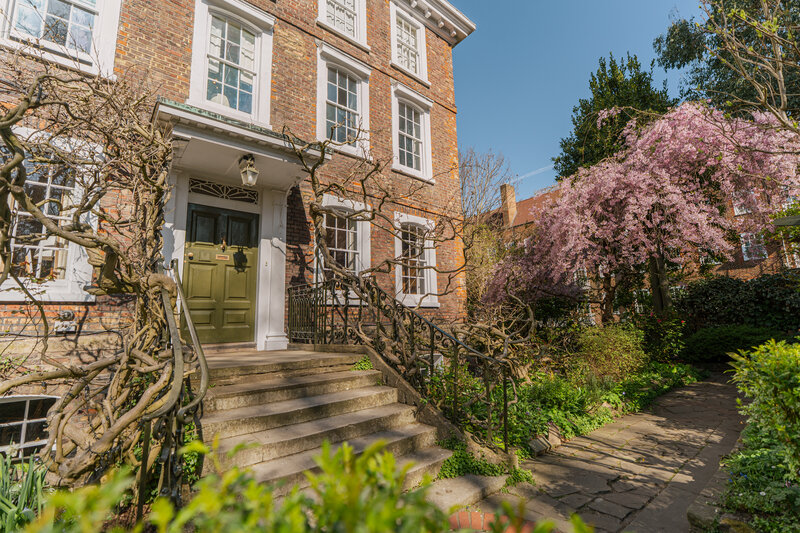
The façade of the building displays patched red brick bands between its three storeys. The central doorway displays a cornice-hood carried by pilasters and brackets of wrought iron.
The house was refurbished and improved in 2006, providing disabled access, the Peggy Jay Community Gallery and bringing the museum up to greater modern standards.