The Lloyd’s Register Building
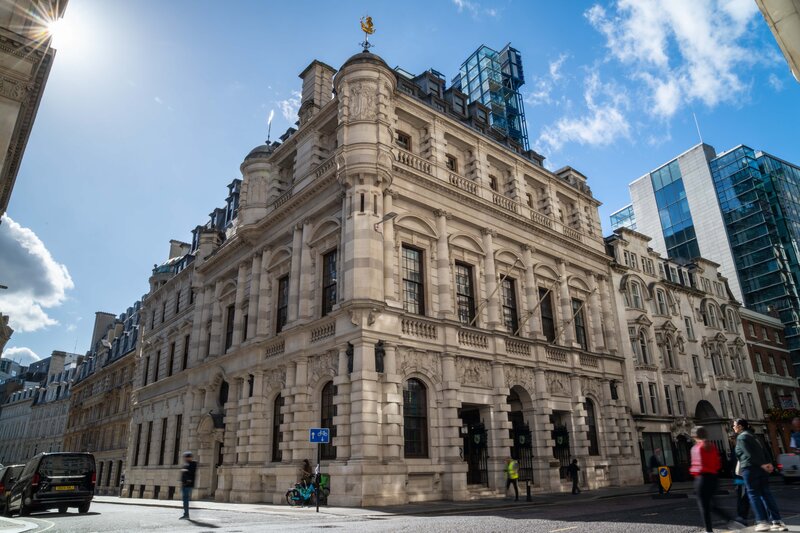
Architect Thomas Edward Collcutt was commissioned to design a building for Lloyd’s Register that expressed confidence and permanence. Collcutt’s vision blended Renaissance inspiration with bold artistic detail. He chose only the finest materials: Portland stone and carved Hopton Wood stone for the façades, and a rich interior palette of marble, mahogany, and oak. Every element - from the stonemasonry to the sculptural work - was crafted by leading artists and master tradespeople of the era.
Construction began in 1899, led by the renowned contractor Mowlems Ltd, whose exceptional stonework had already earned wide admiration. The organisation took possession of the new headquarters in December 1901; a palazzo‑like structure that still stands today as one of the City’s most distinctive architectural achievements.
The General Committee Room
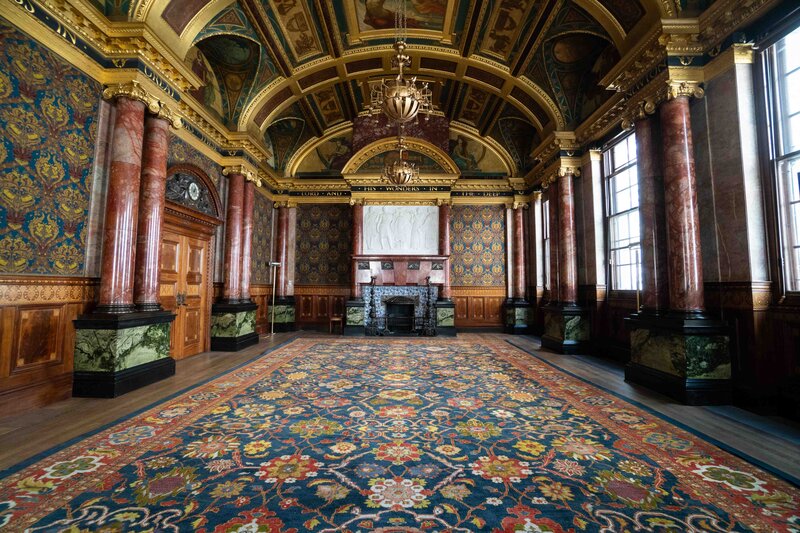
The architectural showpiece of the 1901 building this grand classical saloon was designed to impress. Entered through double mahogany doors, the General Committee Room opens into a soaring, barrel‑vaulted space four bays long, framed by coupled Ionic columns with richly coloured Numidian marble shafts and gilded capitals.
High above, a frieze displays the names Watt, Newton, and Cook, along with Psalm 107 v. 23 & 24 celebrating those who “go down to the sea in ships,” reinforcing themes of exploration, science, and safety.
'They that go down to the sea in ships, that do business in great waters; These see the works of the Lord and his wonders in the deep'.
The walls are lined with mahogany panels inlaid with rosewood and fruitwood, and tapestry hangings based on originals now in the Victoria & Albert Museum. The original 1901 carpet, chosen by Collcutt, still covers the oak floor.
At each end, carved chimneypieces add further grandeur. The west fireplace includes dolphins, gilded detailing, and a Carrara marble relief of the Lloyd’s Register lady by Bertram Pegram, surrounded by Numidian marble columns and William de Morgan tiles. The east fireplace echoes the design in a simpler form, with sea‑horse carvings and an iron grate featuring the Lloyd’s Register monogram.
The room can be furnished with neo‑Georgian mahogany pieces by Maples & Co., combining authority, craftsmanship, and maritime symbolism, a fitting setting for the organisation’s most important discussions.
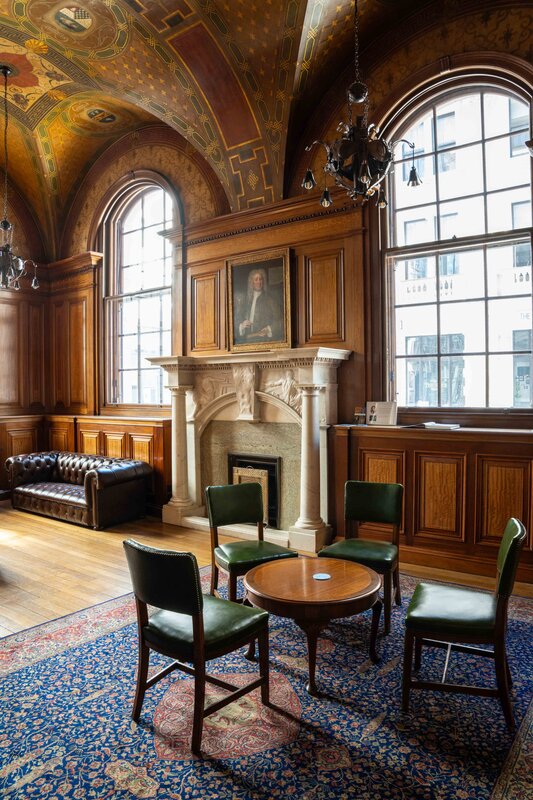
The Old Library
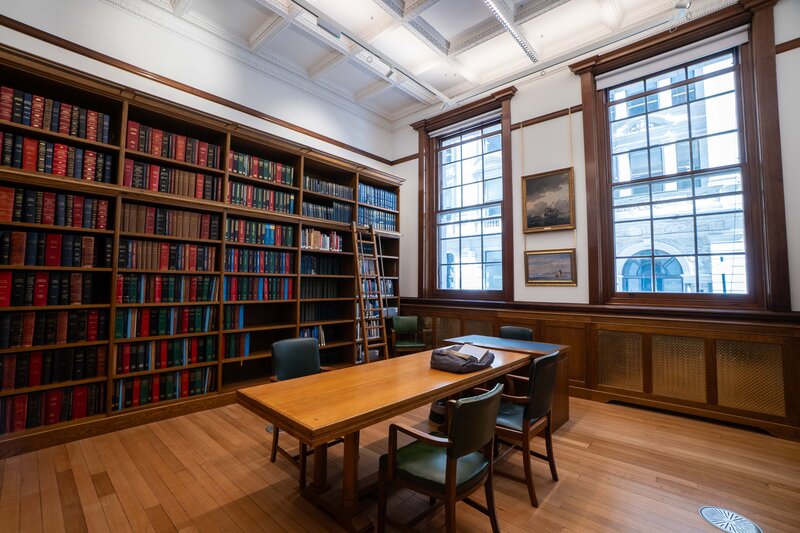
The Old Library is one of the building’s most atmospheric historic rooms — a warm, richly crafted space that reflects a moment of transition in early 20th‑century design. Mahogany bookcases inlaid with rosewood and fruitwoods line the room, their art nouveau floral motifs adding a touch of elegance and lightness.
The upper shelves are delicately glazed, while the lower doors are solid and simply moulded, echoing the refined craftsmanship of Robert Adam’s late 18th‑century style. Alexander Howard, who oversaw the woodwork, insisted on using West African mahogany that had been seasoned for a century, and resisted all requests to stain it darker, instead allowing the wood’s natural colour to shine.
Above, the barrel‑vaulted ceiling glows with intricate stencilling in iron red, beige, and green, created by Shrigley & Hunt. A white marble fireplace by Henry Pegram centres the room, complete with a raised keystone carved with sea horses supported by shipwrights, a quiet nod to Lloyd’s Register’s maritime heritage.
At the room’s centre, paired blue‑grey Doric columns rise from a podium of bookcases, supporting the meeting point of the vaulted ceiling, a dramatic and memorable feature that defines the space.
Reference Library
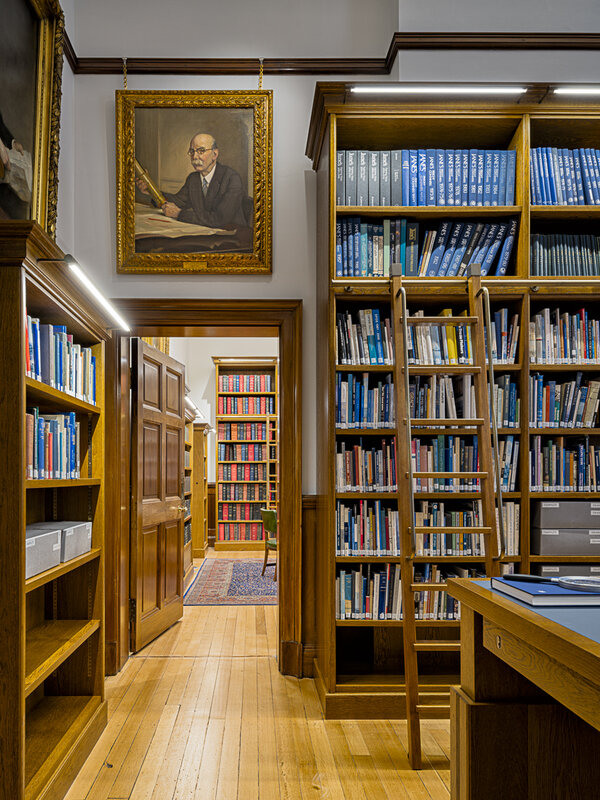
Lloyd's Register’s own historic library was founded in 1852 at the bequest of Principal Surveyor Augustin Francis Bullock Creuze, Principal Surveyor, and a founder member of the first Royal School of Naval Architecture. The New Reference Library now comprises several different collections, including the library of the Institute of Marine Engineers, Science and Technology (IMarEST) and part of the Denny Library collection of the Royal Institution of Naval Architects (RINA).
The Lloyd’s Register Foundation Library collection includes approximately 60,000 items in total and covers topics including the history and development of maritime safety and engineering, navigation, shipbuilding, ship design, engineering and oil and gas companies, shipping companies and shipowners, and the history of the shipping industry more broadly.
Currently approximately 2,500 printed books and pamphlets have been made accessible via our online collections catalogue and are available to browse on the open shelves in the Reference Library at 71 Fenchurch Street.
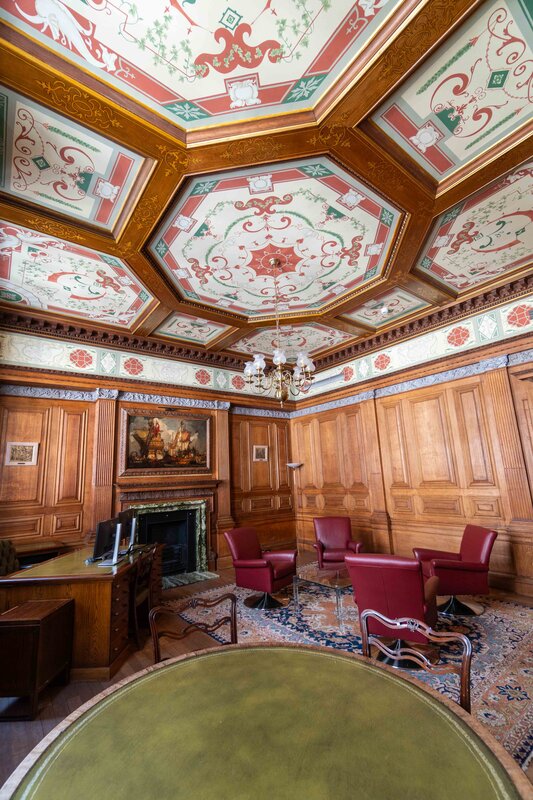
The Chairman’s Office
Once the Classification Committee Room, the Chairman’s Office showcases the elegance and craftsmanship that defined the 1901 building. Its walls are lined with beautifully executed oak panelling, complete with raised and fielded panels and Ionic pilasters, creating a warm and dignified atmosphere.
During restoration work in the late 1990s, the room’s original decorative scheme - including Shrigley & Hunt’s stencilled ceiling - was carefully brought back to life using a historic watercolour as a guide. The ceiling had been lowered for installation of air conditioning units in the 1970s. Today, the ceiling’s ornate beams and patterns once again reveal Collcutt’s eye for detail.
A highlight of the room is the oak chimneypiece, topped with a moulded overmantle that frames The Visit of Queen Elizabeth to Sir Francis Drake at Deptford, a striking canvas by Sir Frank Brangwyn. This piece forms part of Lloyd’s Register’s broader Brangwyn collection, which once adorned committee rooms across the building.
The Chairman’s office was a room designed to impress, and one that still reflects the organisation’s long tradition of craftsmanship and leadership.
Exhibition in General Committee Room
Step inside the story of the Lloyd’s Register Building in an exhibition in the General Committee Room. From its original design and construction in 1901 to later refurbishments, the display reveals hidden and forgotten spaces and explores the broader history and heritage of Lloyd’s Register, and the work of our global safety charity Lloyd’s Register Foundation.
First Floor Landing
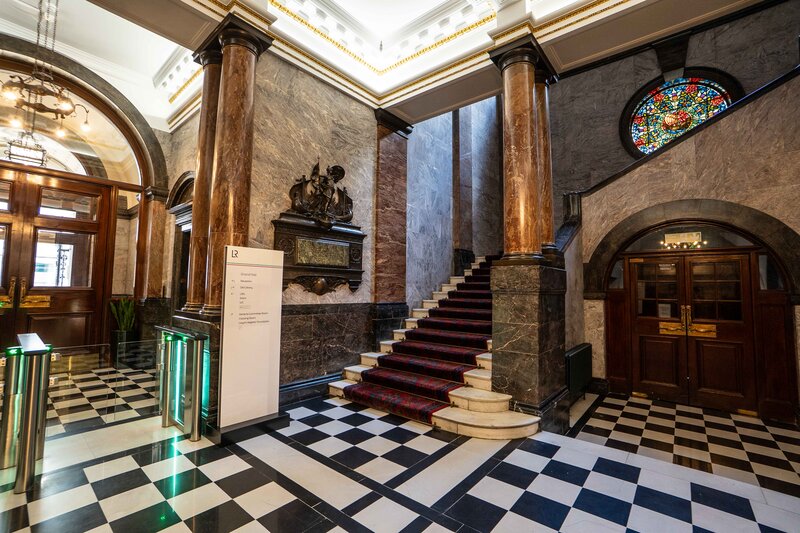
The first‑floor landing is one of the building’s most striking spaces - a gallery‑like setting filled with colour, sculpture, and maritime storytelling. A sweeping bronze frieze by Frank Lynn Jenkins surrounds the landing, depicting ships from Viking longboats to 19thcentury vessels, with elegant symbolic maidens representing ideas like safety, navigation, peace, and justice.
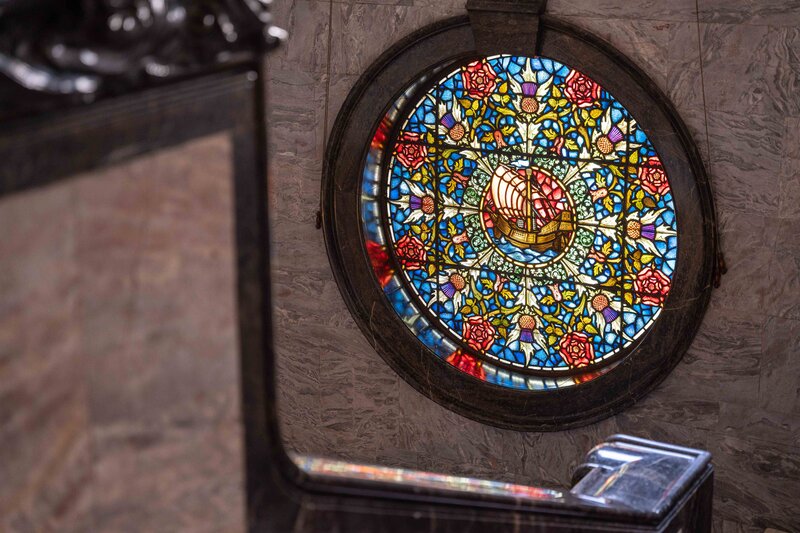
Rich details catch the eye: mother‑of‑pearl highlights in the waves, silver accents, and headdresses set with turquoise and coral. Above, Gerald Moira’s painted vault, decorated with tulips, roses, laurel and fruit adds warmth and vibrancy. Stained glass, bronze panels, and painted lunettes continue the maritime theme, many carrying the ‘LR’ monogram or symbolic scenes such as “safety” and “watchfulness.”
Lloyd’s Register
Lloyd’s Register (LR) is a global professional services group specialising in marine engineering, technology and digital solutions. We were created more than 260 years ago as the world’s first marine classification society to improve and set standards for the safety of ships.
Today we are a leading provider of classification and compliance services to the marine and offshore industries, helping our clients design, construct and operate their assets to accepted levels of safety and environmental compliance.
We also provide advisory services and digital solutions, supporting fleet and voyage performance and optimisation. Through OneOcean, LR delivers integrated digital solutions supporting voyage planning, optimisation, compliance, training and fleet performance across more than 30,000 vessels globally.
In the race to zero emissions, our research, advisory and technical expertise and industry-firsts are supporting a safe, sustainable maritime energy transition.
Lloyd’s Register Group is wholly owned by the Lloyd’s Register Foundation, a politically and financially independent global charity that promotes safety and education
Lloyd’s Register Foundation
Lloyd’s Register Foundation is an independent global safety charity that supports research, innovation, and education to engineer a safer world. Its mission is to use the best evidence and insight to help the global community focus on tackling the world’s most pressing safety and risk challenges. For more information, please visit www.lrfoundation.org.uk