The Livery Companies have their roots in the medieval trade guilds of London. Those working in the same craft lived and worked near each other, grouping together to regulate competition within their profession and maintain high standards. Many of their halls still survive, and ten of them will be open during the Festival. Don’t miss the chance to see inside some of the City’s most unique and intriguing spaces, view archival treasures and objects of fascination.
There are also two walking tours themed around the Liveries and their symbolism.
Late Georgian Livery Hall rebuilt in 1839. Highlights include the main Hall, featuring a stunning 1870s lantern ceiling, and displays of historic arms and armour throughout the building.
Joseph Henry Good, 1839
Livery Hall first built in 1429, much altered then demolished and rebuilt in 1880, destroyed in 1941 except for external walls (W W Pocock). Designed as a showpiece for the craft of carpentry, the third Hall on the site.
William Wilmer Pocock, 1880
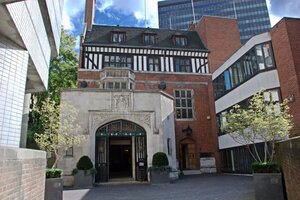
Coopers' Hall is a late 17th century, timber-framed merchant's house with a Georgian frontage. A Livery Hall since 1957, it features a fine Courtoom, dining room and an impressive staircase spiralling up the entire height of the building. The building displays artefacts of the coopers' trade (the making of wooden casks such as barrels) and is the home of the Worshipful Company of Coopers
Nicholas Barbon, 1690
Livery hall first built in the 1530s, twice destroyed by fire and rebuilt (1666 & 1772). Late 19C facade and opulent Victorian interior.
Edward Jarman/John Gorham/Herbert Williams/Sir Thomas G. Jackson, 1860
Farmers and Fletchers' Hall is one of the 44 Livery Halls in the City of London. The Hall is the home to both the Worshipful Company of Fletchers, an ancient Livery Company and the Farmers, a modern Livery Company. The Worshipful Company of Fletchers will open it's doors to show members of the public some of the modern work of the Fletchers Livery, it's traditions and heritage.
Founders’ Hall is the home of the Worshipful Company of Founders (one of the City’s ancient livery companies). Built in the 1980s with a striking and eclectic design, the Hall preserves historic traits whilst embracing modern ideas. Drop in during Open House to explore its treasures, meet members, and enjoy activities for all ages!
Green Lloyd Architects, 1987
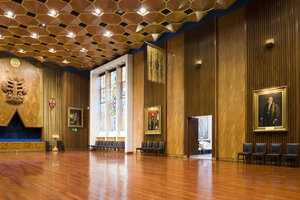
Opened by the Queen in 2002 as one of the first new livery halls in the Square Mile for nearly 40 years, this is a brick building with traditional lime mortar and handsome lead roof, standing around a peaceful courtyard.
Hopkins Architects, 2002
The Hall stands on land which was bought in 1922: construction work, which was undertaken by Holland, Hannen & Cubitts, started that year and the Hall was opened on 17 June 1925. Decorated in the Arts & Crafts style, and resplendent with art and treasures, visitors will gain access to areas not normally open to the public and will be guided by real Company members.
Sydney Tatchell, 1925
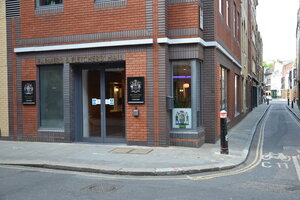
New Livery Hall behind a retained early 20th century façade. This is the seventh Hall in the Leathersellers' Company's history since its foundation in the Middle Ages, and is located on the site of its second Hall.
Eric Parry Architects, 2016
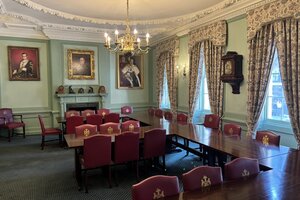
Acquired in 1532 and rebuilt in 1670 after the Great Fire, the Hall was partially destroyed in 1941 by enemy action and rebuilt in a Neo-Georgian style in 1960. The original charter, portraiture and stained glass are of particular interest.
D. E. Harrington, 1961
A curious and enlightening wander through the City of London led by an expert guide. If you know where to look, the past still communicates its secrets concealed within a city that is 2000 years old. We'll discover clues to the City’s past in strange marks and curious symbols along the route, keeping an eye out for honeybees, demi-maidens and sunbursts.
17C livery hall with courtroom and garden. Oak panelling and stained glass windows. Undamaged in WWII. Recently refurbished new rooms and air-cooling within, including a new lift for step-free access into the Hall. Selected items from the archives on display. Book binding exhibition in the Hall.
Robert Mylne, 1673
Trade and craft guilds have flourished for centuries. The City of London’s Livery Companies are unique in their survival, number, and diversity. While the original social and economic conditions that created these original guilds have long been overtaken by modern commerce, these fascinating institutions still flourish today. Join us to explore their enduring history and modern impact.