religious
Arthur Tooley, Nicholas Hawksmoor, Samuel Teulon, 1706
Climb a ladder into the roof space above one of London's best-kept secrets and come face to face with Hawksmoor's beautiful ceiling. Explore Teulon's dramatic architecture, uncover tales of radical thinkers, pioneering doctors and inventive writers, and lose yourself in one of the capital's most secret churches. The roof space tour will be bookable on the day and you'll need to sign a disclaimer.
Holborn
Euston
The roof space tour is not accessible - you need to be confident to climb a ladder to access the roof space.
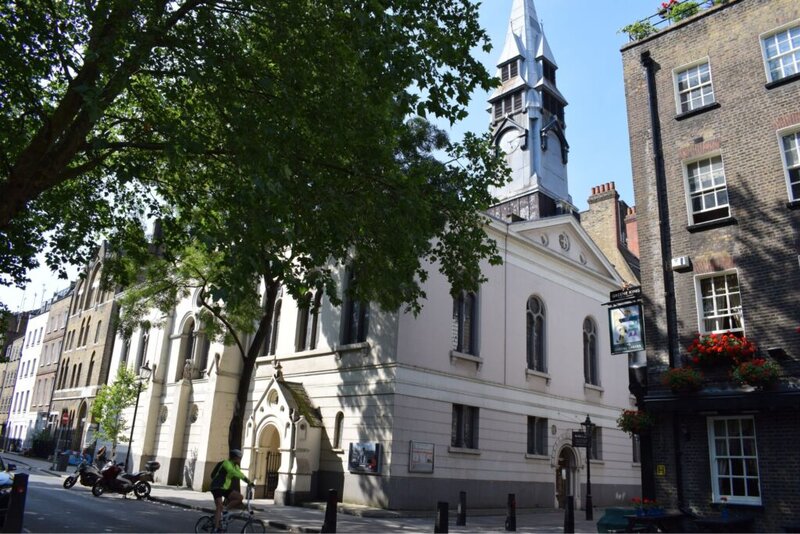
Join us on Sunday 13 September and step into one of London's best-kept secrets: the stunning St George the Martyr church, hidden away on Queen Square in the heart of Bloomsbury. Tucked behind the bustle of Southampton Row and right next to Great Ormond Street Hospital, this remarkable church has stood on the same spot for over three hundred years, quietly holding centuries of stories within its walls.
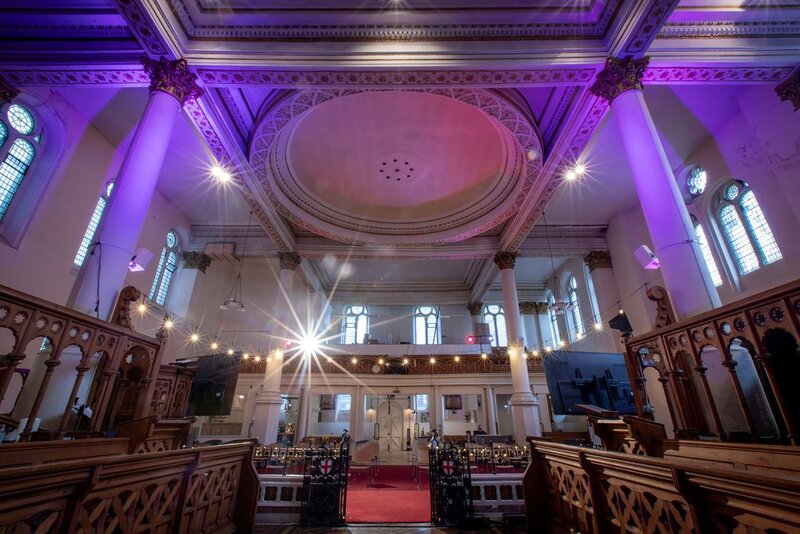
Don't miss the chance to climb the ladder into the roof space above the church and come face to face with Hawksmoor's spectacular ceiling up close, a rare glimpse most visitors never get. Marvel at Teulon's striking architecture, then discover the extraordinary characters linked to this special place: medical pioneer William Stukeley and inventive writer William Brokendon among them.
St George the Martyr will be open on Sunday 13 September from 1-5pm, with tours running every hour. Beyond the roof climbs, enjoy a full day of family-friendly activities: slow-looking sessions, hands-on arts and crafts, and exhibitions revealing exciting plans for the church's future.
Come uncover Bloomsbury's best-kept secret. We can't wait to welcome you.
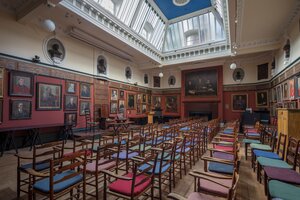
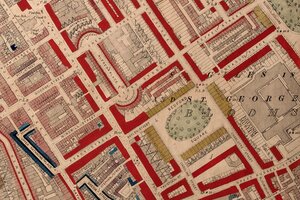
Before the late seventeenth century, the area now covered by St George the Martyr, Queen Square was still rural. Built in 1706, St George’s began life as a chapel-of-ease for the inhabitants of the new houses on Queen Square, which lay some way from the old parish church of St. Andrew’s, Holborn Circus. As London expanded rapidly, the 1711 Commission for Building Fifty New Churches made the chapel a new parish church in 1723. They upgraded and expanded the building, including a magnificent ceiling by Nicholas Hawksmoor, and gave the church responsibilities for education and poor relief in the area. A site was also acquired for a burial ground, now known as St George’s Gardens.
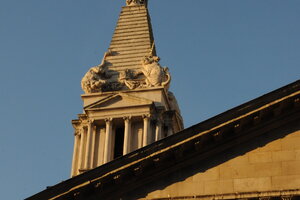
In 1867-68 Reverend John Back employed the English Gothic Revival architect S.S. Teulon to remodel the building. Teulon lived for some time in the parish and his children were baptised in the church. He turned the church to face south instead of east, removing the south and east galleries to create a chancel for a choir and a huge new window, with stone and mosaic reredos depicting Abraham, Moses, Solomon, St Peter, St John and St Paul, along with a new pulpit. He also remodelled the clock and its tower.
The church has a fascinating history and is associated with a range of figures who have changed the architectural, literary, medical and social landscape of the country.
The best-known rector of St George the Martyr was the Revd William Stukeley who led the church from 1747 until his death in 1765. He had a wide-ranging and enquiring mind, and had been a medical practitioner before taking Holy Orders at the age of 42. Turning his expertise in anatomy towards the unpeeling of the layers of history in archaeological sites, he became fascinated by the stones of Stonehenge and Avebury, believing them to be the remnants of pre-Christian Druidic religion, an idea that also inspired the poet William Blake. Stukeley’s careful maps of Stonehenge, as detailed in the book he wrote in 1740, Stonehenge: A Temple Restor’d to the British Druids, are still useful to archaeologists today because they record the site before it was disturbed by other diggings.
Florence Craven Lees pioneered district nursing in London – nursing care provided at home or in convalescent homes. She was friends with Florence Nightingale, served in the Franco-Prussian War and eventually wrote Guide to District Nurses and Home Nursing (1889), which became the central manual for all London nurses. She was awarded numerous medals for her work and became famous before marrying Rev. Dacre Craven, rector of St. George, in 1879.
The multi-talented William Brockedon (1787-1854), artist, travel writer and inventor, was a parishioner for over thirty years and his memorial stone is on the inner north wall of the church. Born into a lower-middle class watchmaking family in Totnes, Brockedon’s talent and energy were spotted by the local rector and he was given an artist’s training at the Royal Academy. Beginning his career as painter of mythological subjects and society portraits, his quest to find the original route Hannibal had taken across the Alps led him to branch out into illustrated travel books for Alpine adventurers, as war receded and tourism became more possible. Often made uncomfortable by mountain weather, he invested in Mackintosh’s new water-proofing system, and used the rubber technology to invent more air-tight seals for chemical flasks. His dissatisfaction with the quality of pencils available for his sketches led him to invent a new kind of artificial compressed lead – graphite, still in use. Unexpectedly, this also led the first accurate pill-compressing machine which required no extra binders or fillers to interfere with the medicine’s effect, a discovery for which he is remembered in the Science Museum today. He is one of the very people to have been a member simultaneously of the Royal Academy, the Royal Geographical Society and the Royal Society, and his portraits of mid-Victorian artists, explorers, writers and scientists can still be seen at the National Portrait Gallery.

Drop in / Guided tour
community/cultural, library, museum, art in the public realm, education
Grade II-listed Georgian domestic building c.1760, formerly part of the Bedford Estate. Interior refurbished 1925 to form lecture hall (restored 2014), library, bookshop and offices. Oak woodwork and green Doulton tiles line the staircase.
Unknown, 1760