religious
, 1911
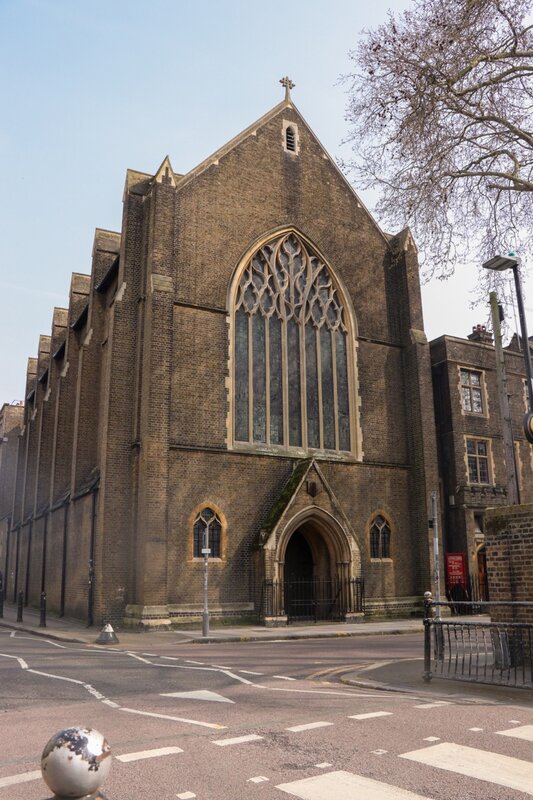
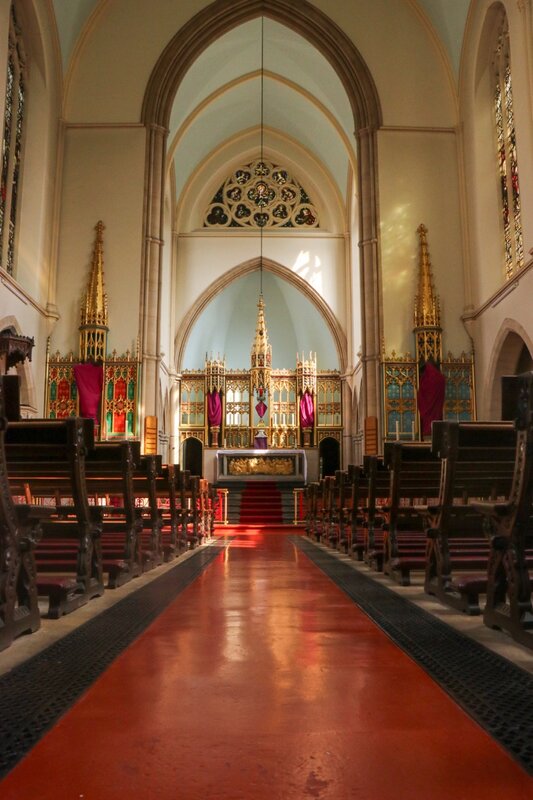
Grade II* listed building designed by Edward Goldie, built in 1911 in the Gothic style with five buttressed bays. Church interior is simple consisting of large nave and high & deep chancel. Nave side walls show shallow-arched recesses into which are fitted finely carved oak confessional boxes and colourful altars and statues throughout. One of only two Assumptionist Parishes in the UK.
Bethnal Green
Bethnal Green, Cambridge Heath
106, 254, 309, 388, D3, D6
Also No 8 bus is near by.
Place of Worship - will be peaceful Tea/Coffee & Cakes - take some time to relax
Our Lady of the Assumption is a thriving Roman Catholic Community that is served by the Assumptionist Order in a Grade II* listed building. Now one of only two Assumptionist Parishes in the UK.
In the nineteenth century, France was a "hot-bed" of political unrest which had serious repercussions for religious practices. In 1899, the Assumptionists came under attack from the government, which was largely because of the influence they exerted through their daily paper, “La Croix”. Faced with imminent expulsion from France, Fr François Picard, the second Superior General, sought to lay firm foundations in other countries. In 1901 the Assumptionists first began their work in England. The Little Sisters of the Assumption, who established their first convent in England in 1880, were largely responsible for the invitation extended to the Assumptionist Fathers by the then Archbishop of Westminster, Cardinal Vaughan, to come to London and establish themselves in his diocese.
The Assumptionists were given "a very poor and abandoned quarter" for which Cardinal Vaughan was "totally unable to provide for". In 1901, Fr Joseph Laity was sent to London by Fr Picard, to look for a house in the Bethnal Green area where he acquired a shop with one room above it and a tiny kitchen.
The first public Mass was said on Sunday 6th October 1901 in the shop of the Assumptionist’s first house, situated on the corner of Globe Road and Digby Street, in the presence of six parishioners. The Little Sisters of the Assumption helped the Fathers to contact groups of Catholics, with a view to starting catechism classes. By December of that year, they had outgrown ‘the shop’ and moved to a former flour store house situated in North Passage (later renamed Peary Place), which led into Green Street (later renamed Roman Road), with noisy public houses found at each end of the passage. This new chapel measured 40 ft x 20 ft and the room above was used for parish meetings.
With the growing attendances at Mass and more priests arriving from France, an agreement was reached with the support of Archbishop’s House to take over the Polish Church on Cambridge Road (renamed Cambridge Heath Road). The first Parish Mass was said in the new church on 9th October 1904. The new church was far superior to the one in North Passage, although it was still a very humble building, as it had been decorated by the Polish Fathers.
The church was to expand still further with the aid of a generous benefactor, Mrs Florence Cottrell-Dormer, who wanted to help build a church in memory of her late husband, Clement Cottrell-Dormer.
The Little Sisters of the Assumption, who were still living in Bow at the time, were approached by Mrs Cottrell-Dormer with an offer to build a beautiful convent and church for the Sisters. The Sisters, not needing a church, sent her to the Assumptionist Fathers, who were living in great poverty and in need of a more suitable church.
An agreement was drawn up between the Congregation and Mrs Cottrell-Dormer on 10th May 1908. Article 6 of the agreement stated: "The architect shall be selected by Mrs Cottrell-Dormer and the plan of the church and all the decorations shall be subject to her approval and no alteration shall be made from the plan approved by her without her consent."
The architect chosen for the project was Edward Goldie, F.R.I.B.A. of Kensington, who was of French origin. Of the two plans considered, the stronger and more expensive of the projected churches was selected. This proved fortunate, as the church had to withstand many bomb blasts during the Second World War and survived with all its fabric intact, with the exception of a few windows.
In May 1910, Fr François Mathis purchased the land on which the present church and Priory now stand, for the sum of £5,857 of which £2,600 was paid by Mrs Florence Cottrell-Dormer. Inscriptions in the stonework above the Holy water font (church’s west wall) in memory of Clement and Florence Cottrell-Dormer, remind us of the "founder" of Our Lady of the Assumption Church.
The foundation stone was laid by Cardinal Bourne on Saturday 6th May 1911. The church was constructed in the Gothic style. Its façade, built in light brick and stone facings, has a large stained glass window above a plain small porch. The side elevation consists of five buttressed bays, each bay with a large window in its upper part.
The building was completed in 1912 and registered at Somerset House as a place of religious worship on 12th June of that year. The first Mass was celebrated in the Church on 22nd June 1912 by the Superior General of the Assumptionist Fathers, Fr Emmanuel Bailly, in the presence of the Cardinal Archbishop of Westminster, the Lord Mayor of Bethnal Green and various religious and civil dignitaries.
The total cost of the church was £9,354 3s 9d, which excluded the cost of the land. Most of this cost was met by Mrs Cottrell-Dormer. A small debt remained on the church, so that it could not be consecrated at once. The consecration was eventually fixed to coincide with the Golden Jubilee of the Church, in June 1962.
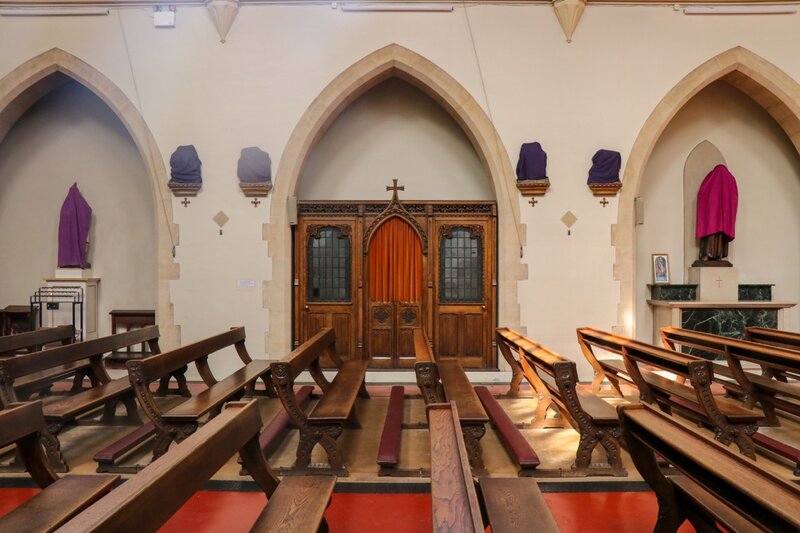
Interior footprint: The interior of the church is quite simple and consists of a large nave and a high and deep chancel only. There are no side chapels opening out of the chancel. Instead, side altars stand to the right and left of the nave against the high walls which flank the high chancel arch.
The side walls of the nave show shallow-arched recesses into which are fitted finely carved oak confessional boxes. The confessional boxes and the benches were carved by an Assumptionist priest, Fr Gregory Chedal, who never actually lived at Bethnal Green. The Assumptionist Motto, ATR (Adveniat Regnum Tuum) can be seen emblazoned on the sides of some of the benches. At the end of the church is a large organ gallery.
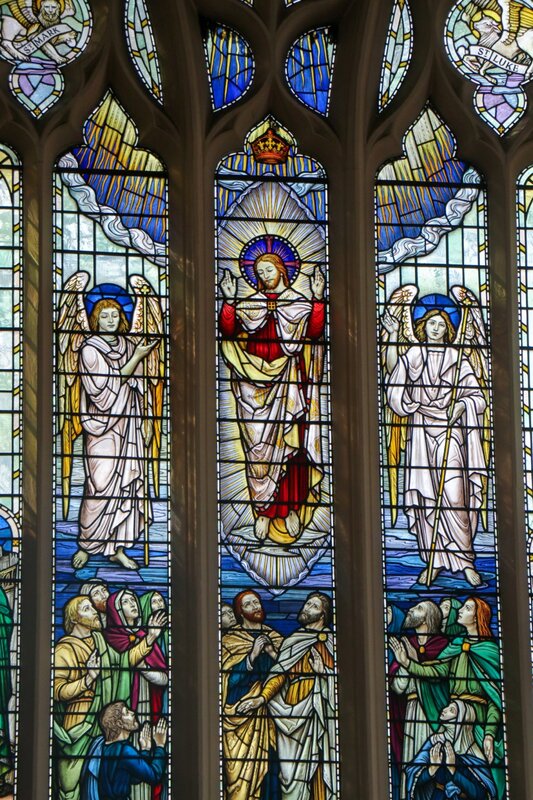
Stained glass windows:The fenestration of the church is unique, in that it consists of large windows in the upper part of the side walls only. There are five windows on each side, with three of the ten windows containing stained glass depicting various saints. The emblem of the Assumption is shown in the rose window in the sanctuary. Nine choirs of angels surround the Assumptionist panel. The windows came from the well-known glass stainer, Hardman. The memorial stained glass west window, installed in 1931, was destroyed by enemy action in the Second World War and replaced in 1951. The solemn High Mass of Dedication for the window formally marked the reopening of the Church following war damage.
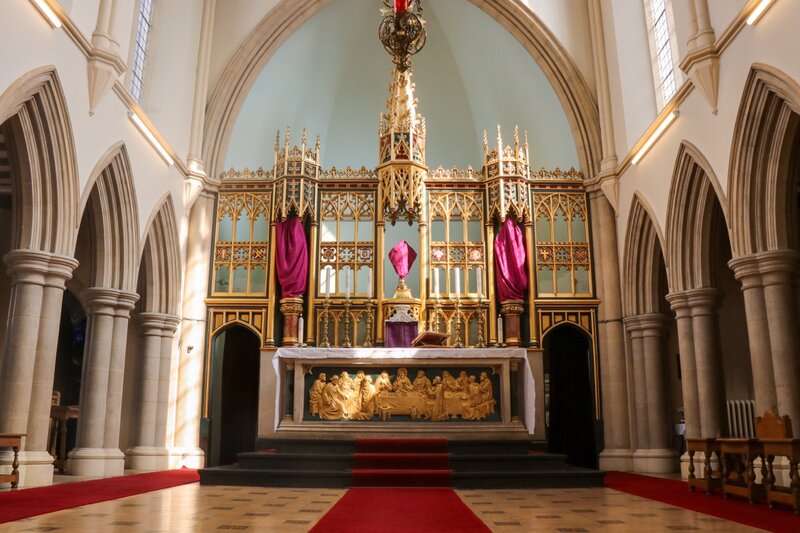
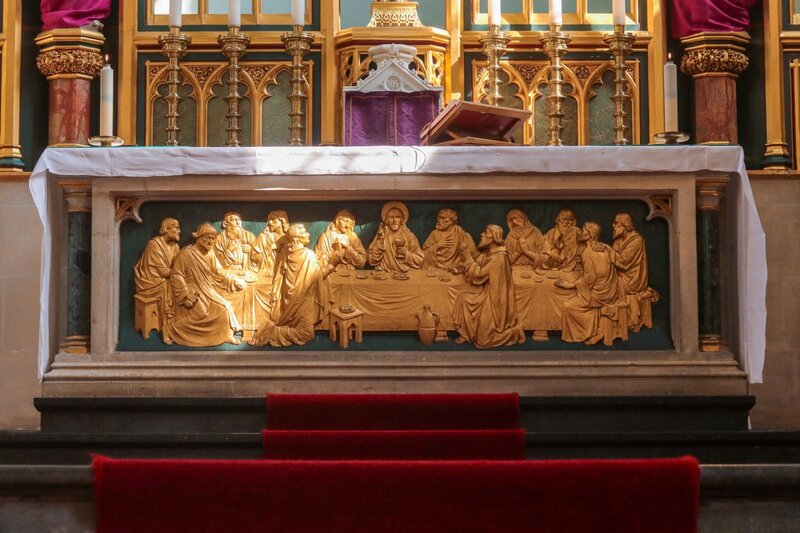
Altars: The church’s High Altar is made of stone with marble incorporated and decorated in gold and deep colours. In 1977 (approximate date) the High Altar was moved forward, so that it could continue being used for the daily celebration of the Mass after Vatican II. The side altars are made of wood and decorated in deep red (Sacred Heart Altar) and blue (Our Lady’s Altar). The statue of Our Lady is the work of the Art and Book Company. The steps of the altar are black marble.
Organ: In 1968, an opportunity arose to acquire a large church organ from St Paul's School in Orpington. This replaced the organ which had been installed in the Church in 1913.
War Memorial: On 11th November 1928 (Armistice Day), Memorial Tablets commemorating the soldiers and sailors of the Parish, who died in the First World War, were blessed and unveiled in the church. The tablets were erected beneath the Great Crucifix on the south wall.